

TL;DR
Choose insurance tracking software that checks contract requirements, manages renewals, and connects approval status to contractor dispatch. Dedicated COI tools suit detailed compliance review; facilities platforms support operational coordination. Test both workflows with real vendor documents before purchasing.
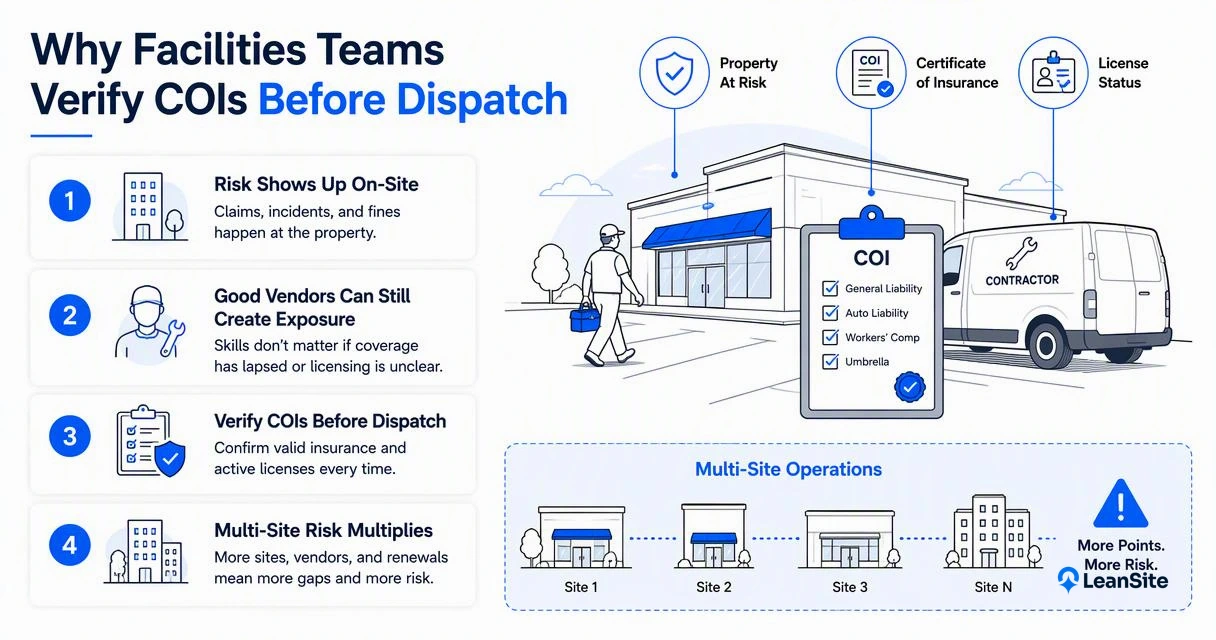
A contractor's insurance certificate can be current without satisfying the requirements for a particular job. Contractor insurance tracking software helps facilities teams distinguish document collection from insurance compliance. For property owners and multi-location operators, the buying decision should center on coverage review, renewal ownership, and dispatch visibility, not simply PDF storage. Leansite belongs in that conversation as a facilities-management option for teams evaluating how vendor coordination fits into maintenance operations.
Table of Contents
What is contractor insurance tracking software?
Contractor insurance tracking software collects insurance documents, tracks expiration dates, and helps teams review contractor coverage against defined requirements. Depending on the product, it may also request renewals, flag missing information, and maintain approval records. Its purpose is to make contractor insurance status usable before work begins and throughout ongoing service.
Insurance terms that shape the buying decision
Certificate of insurance (COI): A document summarizing insurance coverage; it isn't the policy itself.
Endorsement: A policy document that changes or adds coverage terms, including certain additional-insured provisions.
Compliance status: A recorded decision about whether submitted evidence meets the organization's requirements.
Facilities teams should define requirements with their broker or risk adviser. General liability, workers' compensation, commercial auto, and umbrella coverage may apply differently by trade, contract, and jurisdiction.
A collected certificate is evidence for review, not a substitute for reviewing the required coverage.
How should teams track insurance before dispatch?
- Set insurance requirements by trade, property, and contract.
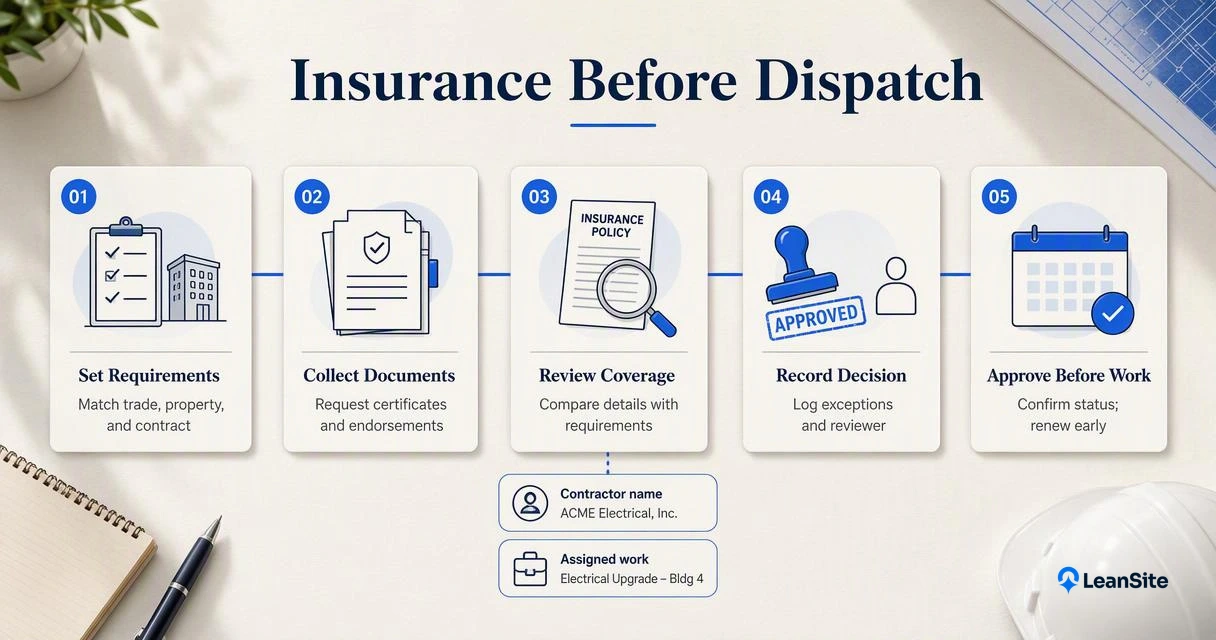
- Collect certificates and required endorsements from each contractor.
- Review coverage details against those requirements.
- Record approval, exceptions, and reviewer ownership.
- Confirm approval before assigning covered work.
- Request renewals early and reassess status when documents change.
Match the legal entity to the actual assignment
A useful review connects the contractor's legal name, assigned work, applicable properties, and required insurance documents. An HVAC vendor working across several buildings may need a different review from a landscaping company serving one site.
For example, a facilities team could schedule renewal reminders 60, 30, and 7 days before expiration. These are illustrative settings, not an industry benchmark. The workflow should name an owner for each unresolved request.
Make approval visible where work gets assigned
Dispatchers need a clear status, review date, and escalation contact rather than another folder to search. The approval record should distinguish approved, pending review, and approved with an authorized exception.
- Attach status to the correct vendor and property.
- Preserve the reviewer's decision and supporting documents.
- Route exceptions to an authorized manager.
The connection to work-order visibility matters because insurance review and job assignment often involve different teams.
Which insurance tracking approach fits the portfolio?
The best approach depends on whether the organization primarily needs document reminders, detailed insurance review, or coordination across maintenance workflows. Compare the actual review process and handoffs before comparing subscription prices.
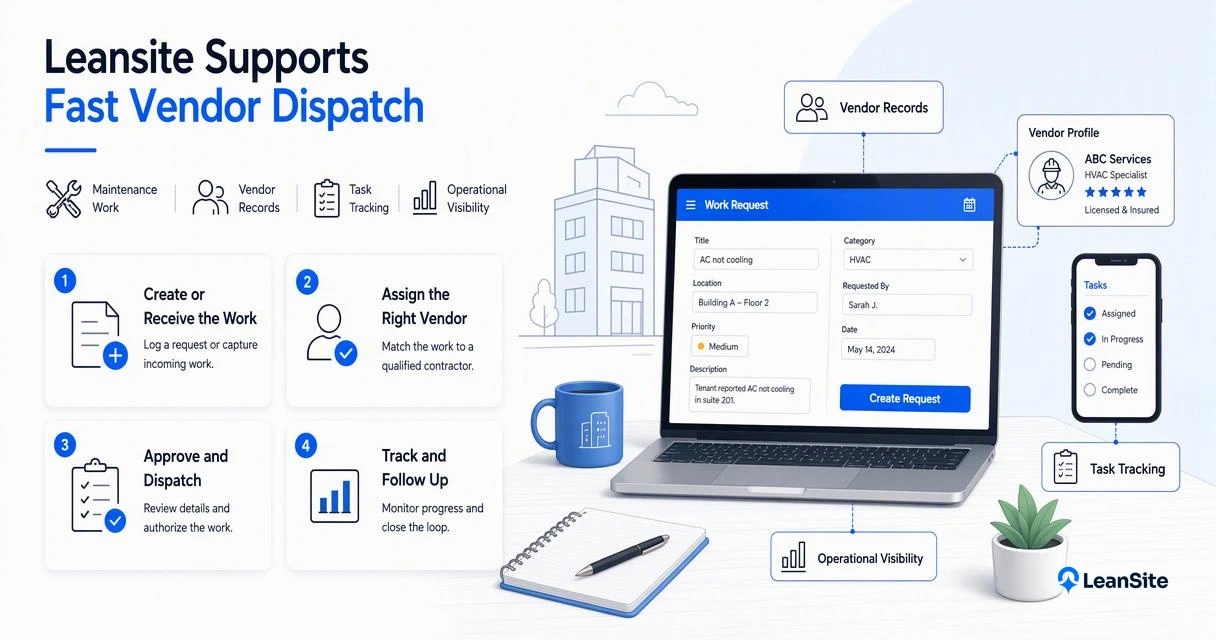
Three approaches compared by operating need
| Approach | Best fit | What to verify |
|---|---|---|
| Dedicated COI platform | High vendor volume or detailed coverage requirements | Endorsement review, requirement rules, renewal follow-up, audit history |
| Facilities platform with insurance workflow | Teams connecting vendor readiness to maintenance assignments | Document handling, approval visibility, dispatch controls, integrations |
| Spreadsheet and shared storage | Small, stable contractor roster | Named ownership, consistent reviews, reliable reminders |
Dedicated COI software and facilities software can complement each other. One may own insurance review while the other presents the approved vendor status during scheduling.
Who should pick which approach?
Risk teams should prioritize dedicated review capabilities when contracts require detailed endorsement checks. Facilities directors should prioritize operational connections when vendor approval affects recurring service across many locations.
The multi-location facilities management guide explains the broader coordination context. For procurement, multi-site maintenance software selection provides a related lens on portfolio workflows.
Compare total cost using vendor count, onboarding effort, review services, implementation, and integration charges. A low subscription price doesn't establish the lowest operating cost.
How Leansite handles this
Leansite is relevant to the facilities-management side of insurance tracking: connecting vendor coordination with maintenance work is the workflow to evaluate in a demonstration. A practical assessment should follow one contractor from onboarding through assignment, document renewal, and management reporting.
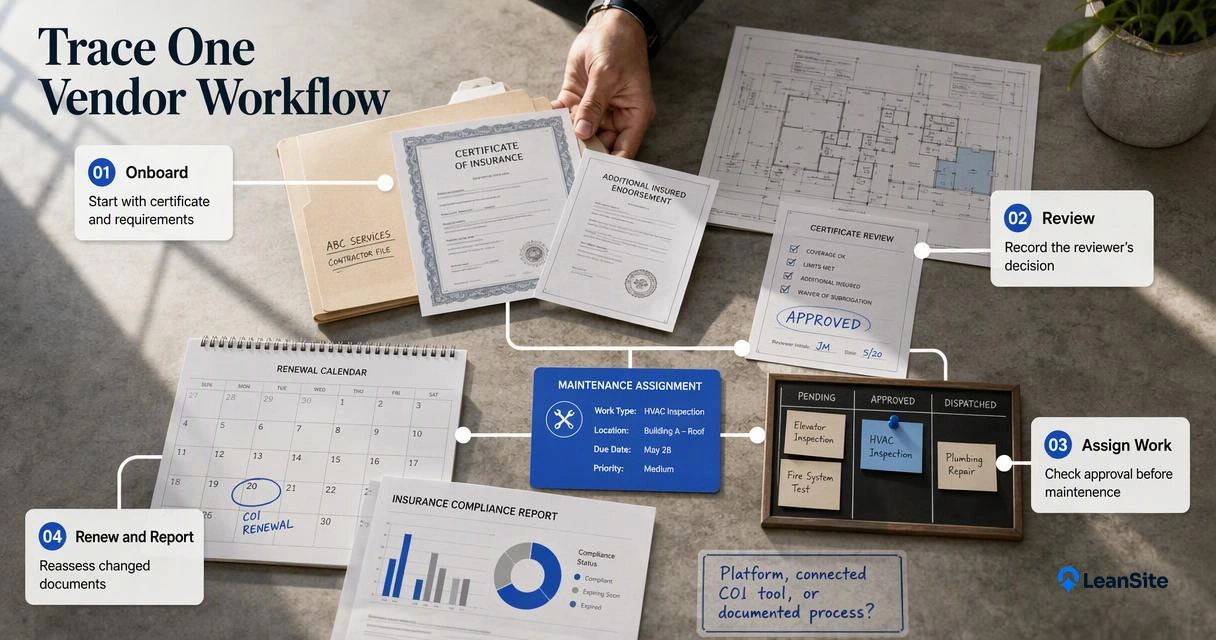
A demonstration built around real contractor records
The demonstration should establish which steps the platform supports directly and which belong in a connected COI system or a documented review process.
- Bring a certificate, an endorsement, and property-specific requirements.
- Follow how a reviewer records a decision.
- Check how dispatch staff see that decision.
- Confirm document export and permission controls.
A clear acceptance test makes purchasing decisions easier for operations, procurement, and risk teams.
What should buyers expect from AI in 2027?
AI-assisted extraction and review suggestions are capabilities to evaluate, not substitutes for accountable insurance decisions. Buyers should ask for traceable document references, confidence indicators, and human review controls.
The 2021 review Artificial intelligence in the construction industry provides historical context, not a 2026 product benchmark. The 2021 paper Digital technologies, new idea, and skills offers broader context for technology adoption. For the operational angle, see AI facility management software.
Conclusion
Choose contractor insurance tracking software around a documented approval workflow, then test it with actual vendor records. Facilities teams evaluating Leansite should prepare one recurring-maintenance scenario and one multi-property contractor scenario for a demonstration. Visit getleansite.com to begin that discussion, with insurance requirements, dispatch responsibilities, and acceptance criteria ready.