

TL;DR
Choose maintenance software that connects inspection deadlines, asset records, corrective work, and completion evidence. Compare maintenance-focused tools with broader compliance platforms, then pilot one inspection workflow before expanding across properties.
A completed maintenance ticket isn't automatically proof of compliance. Maintenance compliance tracking software connects scheduled work with the records needed to show what happened, when, and who approved it. For facility managers and property owners, the buying decision should center on traceable evidence, not just reminders. Leansite belongs in that evaluation for teams exploring coordinated facilities workflows across commercial locations.
Table of Contents
What is maintenance compliance tracking software?
Maintenance compliance tracking software is a system that connects maintenance obligations to scheduled tasks, responsible people, inspection results, and supporting records. It helps facilities teams track deadlines and retrieve evidence for reviews. The software supports compliance management, but applicable requirements still depend on the asset, location, contract, and governing authority.
Maintenance compliance tracking: The process of recording required maintenance, checking its completion, and retaining evidence against a defined obligation.
CMMS: A computerized maintenance management system used to organize assets, maintenance schedules, work orders, and service history.
GRC: Governance, risk, and compliance, a broader approach to managing organizational oversight, risk, and regulatory obligations.
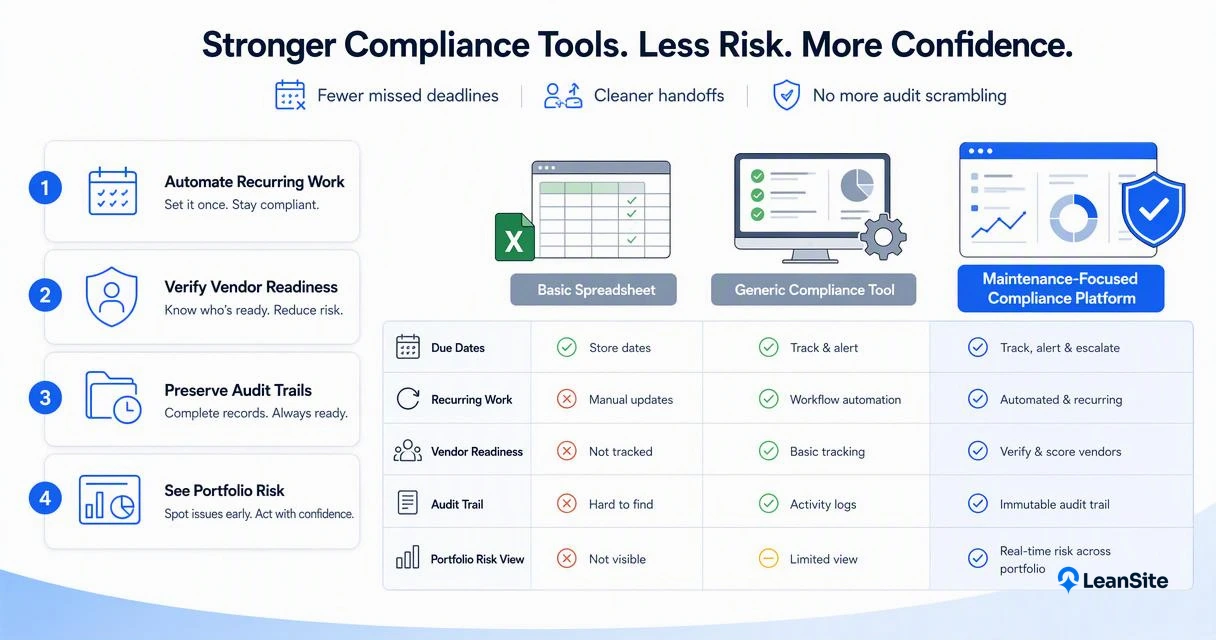
Maintenance tracking versus broader compliance tools
The right category depends on whether the main task is managing physical maintenance or coordinating organization-wide controls.
| Approach | Main purpose | Best-fit workflow |
|---|---|---|
| Maintenance-focused CMMS | Connect assets, schedules, and work records | Equipment inspections and corrective repairs |
| Enterprise GRC platform | Coordinate risk, controls, and compliance programs | Cross-department oversight and regulatory reporting |
| Spreadsheet with shared folders | Manually track deadlines and documents | A limited, clearly owned inspection register |
MetricStream's Connected GRC offering represents the broader enterprise category. Facilities buyers should compare categories against actual workflows rather than treating every compliance platform as interchangeable.
Which features make maintenance records audit-ready?
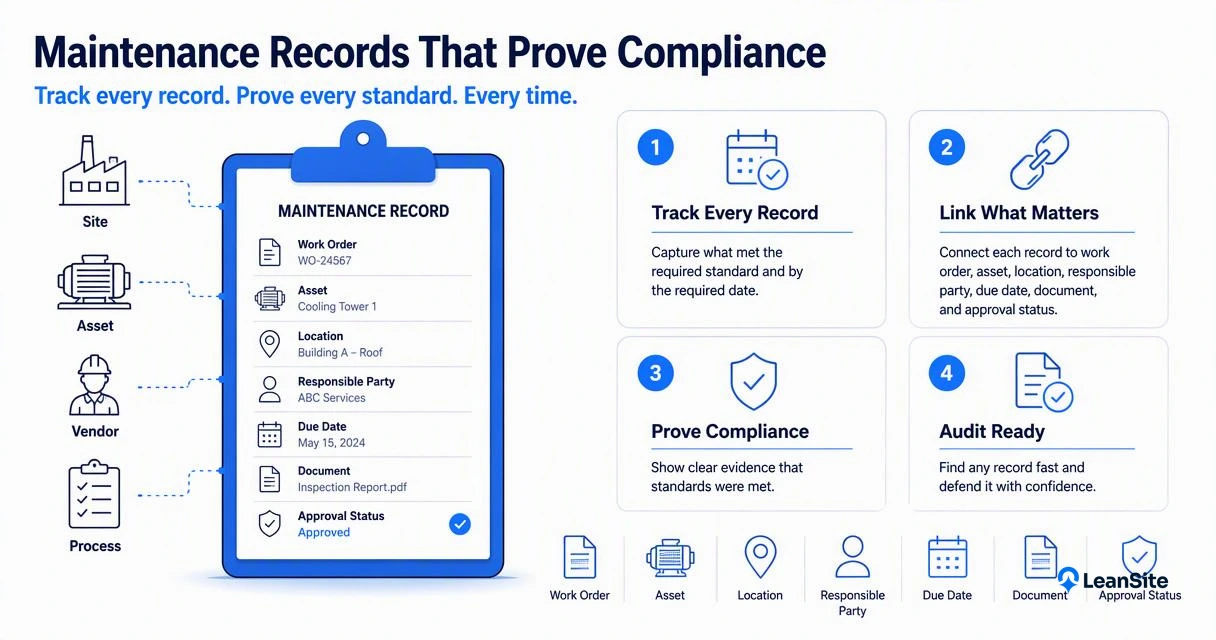
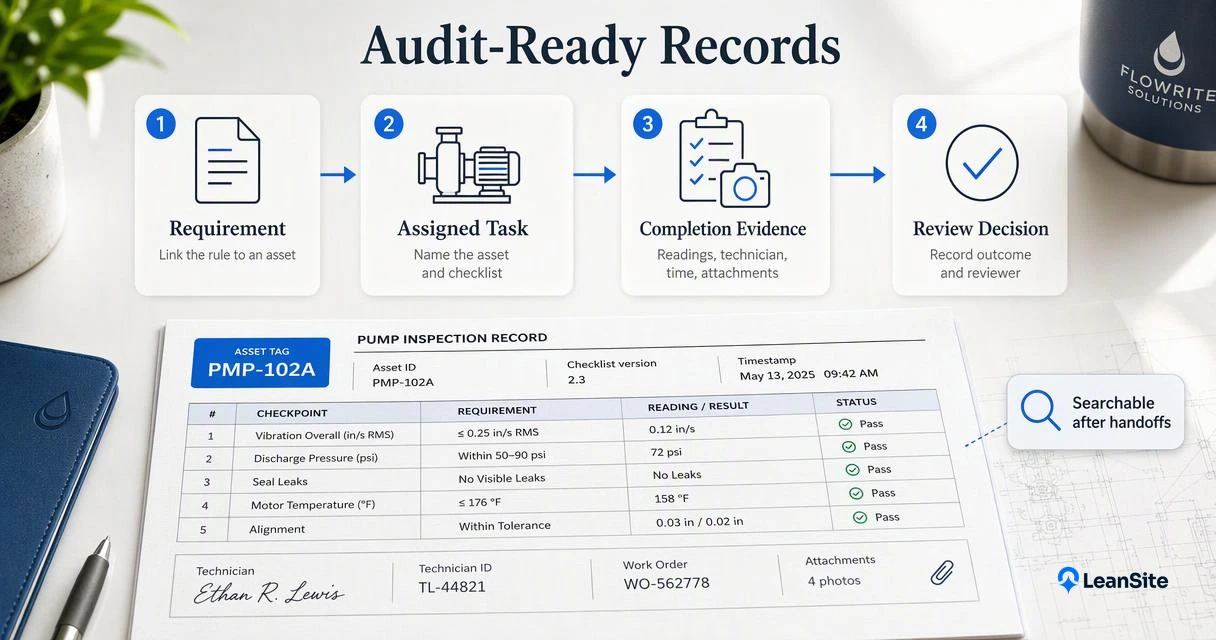
Audit-ready maintenance records connect each requirement to an asset, an assigned task, completion evidence, and a review decision. Buyers should assess how those records remain searchable after staff changes, vendor handoffs, and schedule updates. A dashboard becomes useful when its status can be traced back to the underlying inspection.
Require an evidence chain, not just a completion checkbox
An inspection record should explain both the work performed and its outcome. For example, a pump inspection might record the asset identifier, checklist version, readings, technician, timestamp, attachments, and reviewer.
- Requirement reference: Identify the obligation and its source.
- Due-date logic: Record the frequency, trigger, and responsible owner.
- Completion evidence: Retain readings, photos, certificates, or signed reports as appropriate.
- Corrective-action link: Connect a failed inspection to follow-up work.
- Change history: Show relevant edits, approvals, and rescheduling decisions.
- Export capability: Retrieve records by property, asset, date, and requirement.
Retention periods and approval rules should come from applicable obligations, not a universal software default.
Keep portfolio reporting grounded in local requirements
Portfolio reporting should distinguish completed tasks from overdue work, open findings, and records awaiting review. A standardized checklist can improve consistency, but local requirements may require different frequencies or evidence.
The guide to maintaining visibility across multiple locations provides related operational context. Mobile access also deserves a field test wherever connectivity varies; the discussion of offline maintenance workflows can inform that test.
A useful compliance dashboard makes the evidence behind each status easy to inspect.
How should teams implement compliance tracking?
- Inventory maintenance obligations by asset and location.
- Validate each requirement with the responsible specialist.
- Define schedules, evidence fields, owners, and approvals.
- Pilot one inspection workflow with technicians and vendors.
- Test exceptions, exports, and access permissions.
- Expand after reviewing evidence quality and adoption.
Build the requirement register before automating
The requirement register should identify the asset, obligation source, interval, accountable role, required evidence, and record-retention rule. Manufacturer guidance, service contracts, insurer conditions, and regulatory duties should remain distinguishable.
A quarterly inspection can serve as a pilot example where that interval is appropriate. The workflow should demonstrate scheduling, assignment, evidence collection, review, and retrieval. The preventive maintenance ticket-flow guide offers a useful operational starting point.
Test exceptions before the wider rollout
Exception testing should cover a failed inspection, an unavailable vendor, a missing attachment, and a changed deadline. Each scenario needs a clear owner and an escalation path. The system should preserve the distinction between completed work and an unresolved finding.
Record-sharing rules matter when outside contractors submit evidence. Define who can upload, edit, approve, and view documents before inviting vendors. Related guidance on vendor dispatch automation helps connect those responsibilities to daily operations.
Pilot measurements can include overdue required tasks, missing evidence, open corrective actions, and time spent retrieving records. Establish a baseline before setting improvement targets.
How Leansite handles this
Leansite is a relevant option for evaluating how facilities task tracking, maintenance coordination, and multi-location oversight can support a compliance workflow. The evaluation should connect those operational needs to a concrete inspection scenario, with the buying team observing how records move from assignment through review.
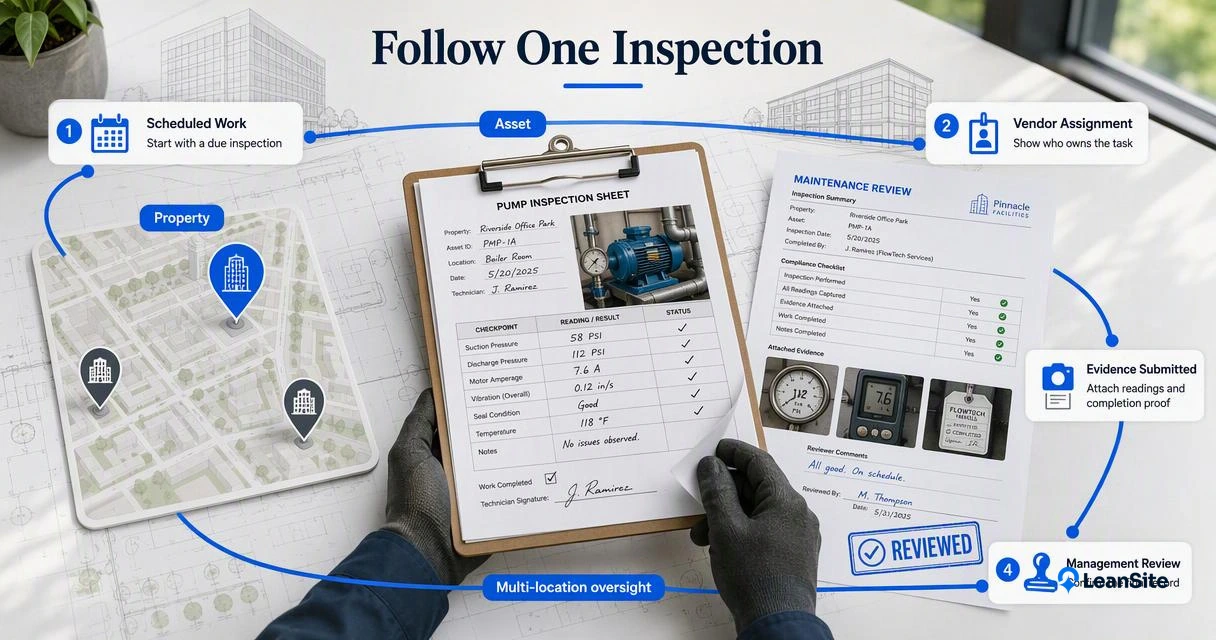
Use a scenario-based product demonstration
A useful demonstration follows one asset through scheduled work, vendor assignment, evidence submission, and management review. That gives facility managers and property owners a shared way to assess workflow fit.
- Trace an inspection to its property and asset.
- Review how supporting documents attach to the work record.
- Follow a corrective task through assignment and approval.
- Retrieve the resulting history for a portfolio review.
The multi-location facilities management guide provides context for evaluating location-level responsibilities alongside central oversight.
Who should choose a maintenance platform versus GRC?
Maintenance-led teams should prioritize asset records, task execution, vendor coordination, and evidence retrieval. Organizations managing enterprise-wide risk and policy controls may need GRC alongside their maintenance system. Selection should follow the required workflow and verified capabilities, rather than the broadest feature list.
Conclusion
Select maintenance compliance tracking software by testing one real requirement from scheduling through evidence retrieval. Document the acceptance criteria, involve the technician and reviewer, and compare results before expanding. For teams considering Leansite, visit getleansite.com and request a demonstration centered on one asset, one inspection, and one review-ready record.