

TL;DR
Strong request intake software gives tenants one place to report issues and gives facility teams a clean path from request to work order. The best 2026 setup combines mobile portals, photo evidence, triage rules, SLA tracking, vendor dispatch, and owner-ready reporting.
Missed maintenance requests usually start small: a tenant email, a hallway note, a voicemail, then a duplicate follow-up when no one can see the status. Maintenance request software for tenants and facility teams fixes that gap by turning every issue into a trackable record with priority, location, photos, assignee, SLA, and history. For commercial properties and multi-site operators, Leansite brings that intake-to-resolution flow into one platform built for facilities work, vendor coordination, and operational visibility.
Table of Contents
What is maintenance request software for tenants and facility teams?
Maintenance request software for tenants and facility teams is a digital system for submitting, triaging, assigning, tracking, and reporting building maintenance issues. It replaces scattered email, phone calls, paper forms, and spreadsheets with a shared workflow that connects tenants, facility managers, technicians, vendors, and property owners.
Maintenance request software: a cloud-based work intake and tracking system that converts tenant or staff issues into actionable maintenance records.
A modern request platform often runs as software as a service, which Wikipedia defines as a cloud model where a provider delivers application software while managing the underlying resources. That matters because tenant portals, mobile updates, and vendor workflows need access across locations, not just from a desk.
Key takeaway: A request portal is not just a form. It is the front door for maintenance data, response accountability, and cost control.
Core users and responsibilities
- Tenants: submit issues, attach photos, view status, and confirm completion.
- Facility teams: triage requests, assign work, manage SLAs, and document fixes.
- Vendors: receive dispatch details, upload proof of work, and close jobs faster.
- Owners and operators: review costs, response times, asset trends, and portfolio risk.
Teams still using inboxes and spreadsheets often lose time to manual sorting. The pattern is common across multi-location operations, as described in Leansite's guide to why multi-site maintenance teams still rely on email and spreadsheets.
How should intake portals capture maintenance requests?
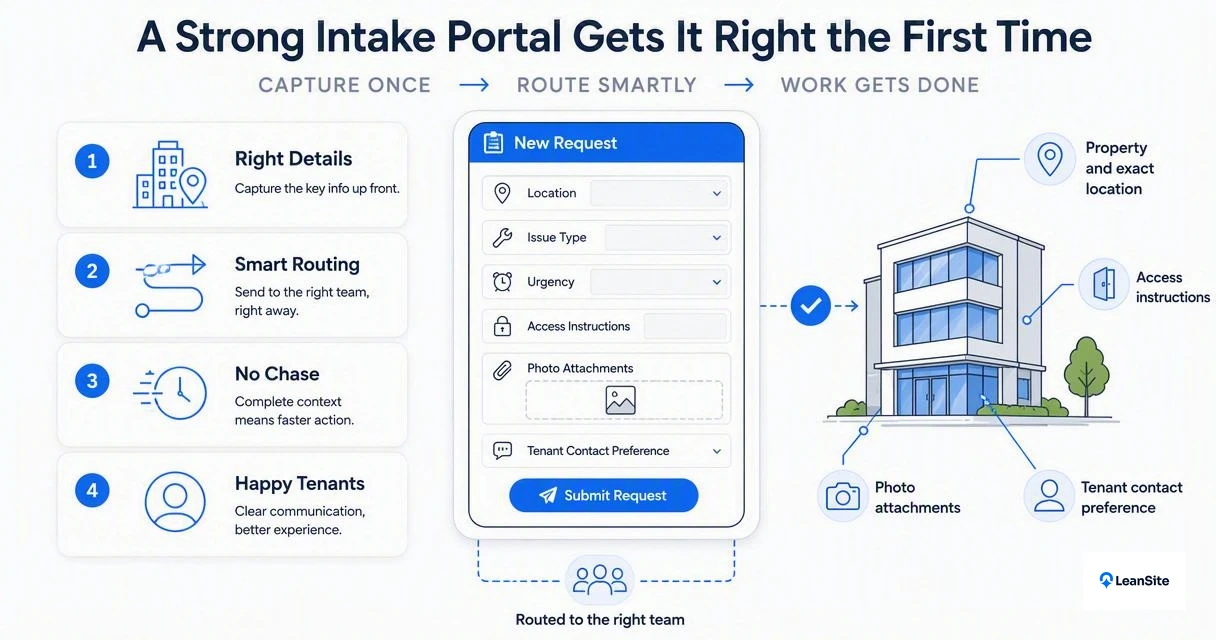
A strong intake portal captures the right details once, then routes the request without forcing facility teams to chase context. The best portals ask for location, issue type, urgency, access instructions, photo attachments, and tenant contact preference before the work order is created.
Required intake fields
- Property and exact location: building, floor, suite, room, asset, or zone.
- Issue category: HVAC, plumbing, electrical, janitorial, safety, access, or general repair.
- Priority signal: emergency, urgent, routine, cosmetic, or inspection-related.
- Photos or video: visible proof that reduces back-and-forth.
- Access notes: business hours, security rules, tenant availability, and lockbox details.
- Communication preference: portal update, SMS, email, or manager note.
Photo attachments are especially useful for vendor dispatch. A leaking ceiling tile, broken door closer, or damaged dock plate can be assessed before anyone rolls a truck. That shortens diagnosis time and helps managers avoid sending the wrong trade.
Request channels that should feed one queue
Tenant portals work best when every request channel lands in the same queue. Email forwarding, QR codes, mobile forms, web portals, and manager-created requests should all create standardized records.
Older paper workflows create uneven data quality because each person describes work differently. Leansite's article on why maintenance teams still use paper work orders explains why that habit often reflects tool fit, not team resistance.
How do triage workflows reduce delays and duplicate communication?
Triage workflows reduce delays by sorting requests by risk, location, asset, trade, and SLA before work begins. Instead of treating every message as equal, facility managers can route urgent issues fast, merge duplicates, and keep tenants updated from one record.
A practical triage sequence
- Validate the request: confirm location, issue type, and required access.
- Check for duplicates: merge repeat reports from the same area or asset.
- Set priority: classify safety, uptime, comfort, compliance, and cosmetic work.
- Assign ownership: send to in-house staff, a vendor, or a property manager.
- Start the SLA clock: track response and resolution targets.
- Update the requester: share status changes without a separate email thread.
This structure matters for tenant trust. A short status update often prevents three follow-up calls. It also gives technicians a cleaner job history when similar issues return.
Vendor dispatch without the phone tree
Vendor coordination is smoother when the request record includes trade, site rules, photos, approval limits, and completion requirements. For national brands or dispersed portfolios, dispatch automation can reduce handoffs between store staff, facilities, accounting, and the vendor network.
For a deeper look at the dispatch side, Leansite's guide to vendor dispatch and predictive maintenance automation for multi-site teams covers how request history can support smarter routing and recurring repair reduction.
Which features matter most in 2026?
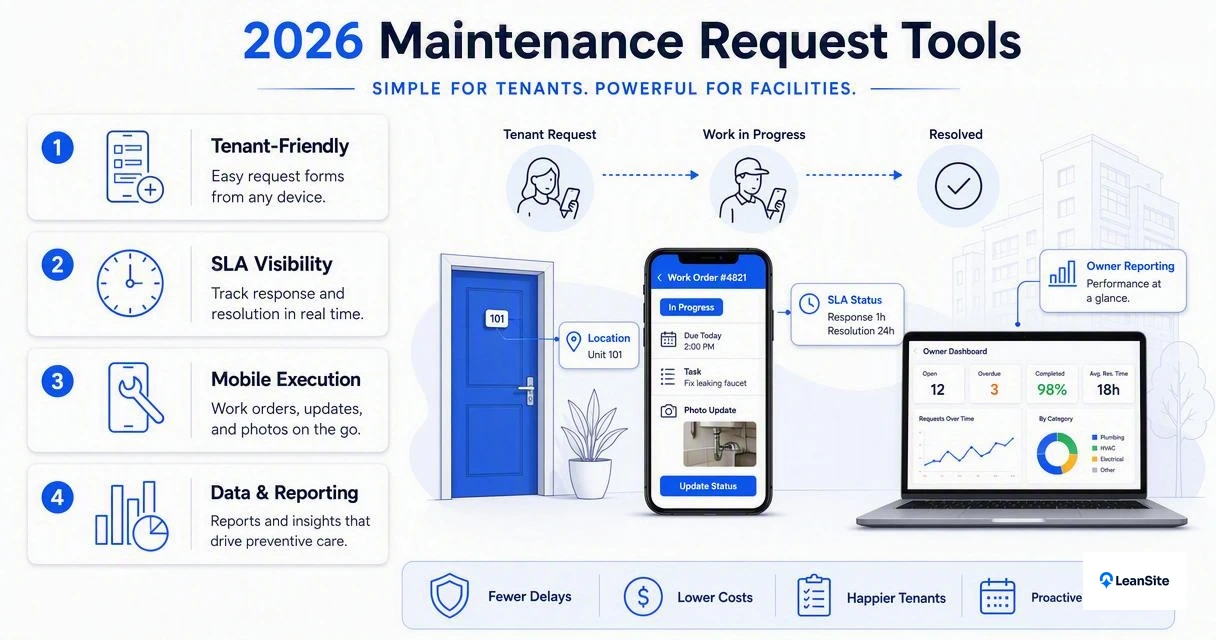
The most useful 2026 maintenance request tools combine tenant-facing simplicity with facility-grade control. Request forms are only the start; the real value comes from SLA visibility, mobile work execution, owner reporting, and data that supports preventive maintenance.
Feature comparison for request-heavy properties
| Feature | Why it matters | Best fit |
|---|---|---|
| Tenant portal | Creates one official intake path | Office, retail, industrial, mixed-use |
| Photo attachments | Improves diagnosis before dispatch | HVAC, leaks, damage, safety issues |
| SLA tracking | Shows response and resolution performance | Owner-managed and outsourced teams |
| Status updates | Reduces duplicate calls and emails | Tenant-heavy commercial buildings |
| Vendor dispatch | Sends complete job details to third parties | Multi-site and specialty trade work |
| Mobile work orders | Lets techs update jobs in the field | Campus, warehouse, and remote sites |
| Reporting dashboards | Connects requests to cost and asset trends | Owners, operators, facilities directors |
The Leansite platform fits teams that need request intake, work tracking, vendor coordination, and portfolio visibility in one operating layer. Multi-building teams comparing category options can also review the complete guide to multi-location facilities management software.
Data turns requests into maintenance strategy
Request data can reveal chronic asset failures, tenant-impacting issues, vendor response gaps, and avoidable repeat repairs. That is where reactive work starts feeding a preventive plan.
"In God we trust; all others must bring data.", W. Edwards Deming, The W. Edwards Deming Institute
Research on cloud systems continues to focus on efficiency and resource management, including the 2022 survey by Avita Katal, Susheela Dahiya, and Tanupriya Choudhury on energy efficiency in cloud computing data centers. In facilities, the same practical idea applies: better systems should reduce waste, not add admin burden.
What should owners and operators expect in 2027?
Maintenance request systems are moving from passive ticket queues toward AI-assisted operations. By 2027, leading platforms will likely classify requests automatically, recommend vendors, flag repeated asset failures, and draft tenant updates based on job status and SLA rules.
Near-term changes to watch
- AI triage: automatic categorization by asset, trade, urgency, and location.
- Edge and mobile intelligence: faster field updates where connectivity is limited.
- Predictive work planning: request trends feeding preventive maintenance schedules.
- Owner dashboards: clearer views of spend, downtime, vendor performance, and repeat issues.
Academic work on AI, edge, and fog computing, including the 2022 systematic review by Sundas Iftikhar, Sukhpal Singh Gill, and Chenghao Song on AI-based fog and edge computing, points toward more distributed decision support. Facility teams will feel that shift through smarter mobile tools and faster field workflows.
Teams planning beyond reactive maintenance can pair request history with asset strategy. Leansite's article on maximizing facility uptime with predictive maintenance is a useful next read.
Conclusion
The strongest maintenance request software for tenants and facility teams gives every issue a clear path: submit, triage, assign, update, close, and report. That path reduces missed requests, cuts duplicate communication, and gives owners better visibility into maintenance cost and performance. Facility leaders evaluating a 2026 upgrade should map current intake channels, define SLA rules, require photo-based documentation, and test reporting with real properties. For teams that want a practical platform built around that operating flow, Leansite is available at getleansite.com.